
Seed and mulch for Piedmont clay
Hydroseeding in Raleigh, NC
New lawns, bare lots and raw banks sprayed green across Raleigh and Wake County, timed around fescue season and storm season.
- No-cost visit to the lot, then a quote in writing
- Fescue, bermuda or zoysia picked for your light and the time of year
- Silt fence, grading and seeding handled together
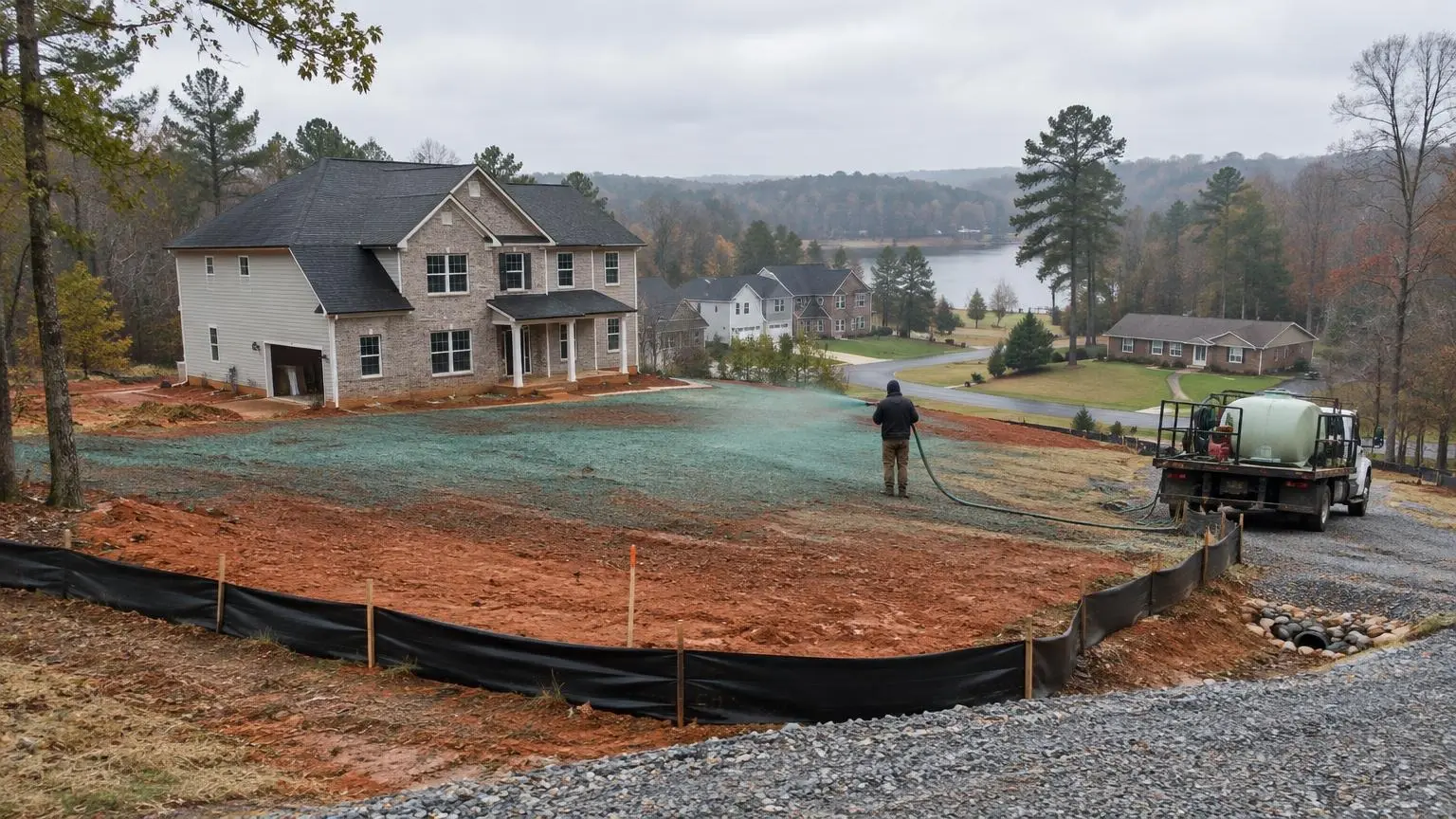
Grass From a Hose, on Red Clay Ground
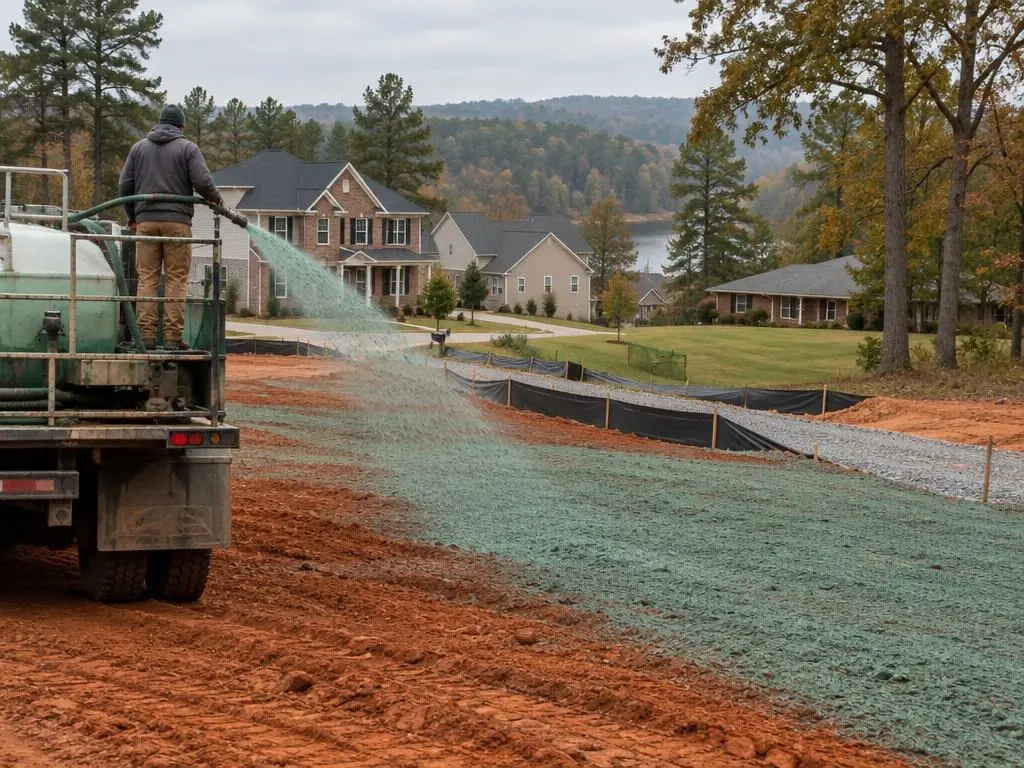
Hydroseeding in Raleigh means spraying grass seed, water, fertilizer, wood fiber mulch and a tackifier together as one slurry across prepared soil in a single pass, so the seed lands already covered and glued in place. We do it for new homes, rebuilt yards, cleared lots, road shoulders and banks across Raleigh and the surrounding Wake County towns. Hydro seeding is the middle ground between sod and a bag of seed spread by hand: it costs less than sod, covers bare dirt faster and more evenly than dry seed, and it is the way most builders and site crews here get a lot covered before the next storm comes through.
The ground under a Raleigh yard
The city sits on the fall line, where the gently rolling Piedmont starts to slope east toward the flat Coastal Plain. On the Piedmont uplands, one of the most widespread soils is the Cecil series. The USDA describes it as a sandy loam surface over a subsoil of red clay, on slopes from nearly flat to 25 percent, and notes that its eroded phases have a surface of sandy clay loam or clay loam instead. In plain terms, on many lots the thin brown topsoil is gone, scraped off during construction or washed away long ago, and the seed ends up sitting on red clay. Clay holds nutrients well, but it crusts hard in summer and sheds water quickly on a slope. That is why we look at the soil before we quote, and why some yards need topsoil or tilling before any seed goes down.
Rain, heat and the calendar
Raleigh averages about 46 inches of rain a year under the 1991 to 2020 normals. September is the wettest month, averaging a little over 5 inches, and late summer into early October is when tropical storms are most likely to reach the area. That timing matters, because early fall is also the best time to seed tall fescue. Mulch and tackifier are what keep seed in place when a band of heavy rain arrives a week after spraying, and on bare slopes we add more of both, or step up to a bonded fiber matrix or a straw erosion control blanket. Summer brings the opposite problem: the city logs about 48 days a year that reach 90 degrees, which is hard on young cool-season grass that has not rooted yet.
Picking a grass and a seeding window
Raleigh falls in USDA hardiness zones 7b and 8a, the transition zone where both cool-season and warm-season lawns are grown. Tall fescue keeps its color through most months and copes with the shade of the City of Oaks far better than bermuda, but it should be sown in late summer or fall so it can root before the next summer's heat. NC State's turf specialists say spring-sown fescue is more prone to drought, heat, disease and weeds, and advise getting fall seed down by mid-October, since germination slows after that. Bermuda and zoysia want full sun, thrive in July, go tan after frost, and are seeded in late spring and early summer once the soil is warm. We match the seed mix to how much sun the yard gets, how it will be used and when you want the work done. If the calendar is wrong for the grass you want, we will tell you, and we can hold the ground with erosion mulch until the right window opens.
Sod, hydroseed or dry seed
- Sod gives you a finished lawn the day it is laid, at the highest price. HomeGuide's range for laid sod is $1 to $4 a square foot; for hydroseeding it is 12 to 35 cents a square foot. Sod also needs decent soil under it, or the roots sit on clay and struggle.
- Hydroseed costs a bit more than dry seed and much less than sod. Sprouts usually show in 5 to 7 days in good conditions, and most lawns are ready for a first mowing in 4 to 6 weeks.
- Dry seed spread by hand or with a broadcaster is the cheapest, but without a mulch layer it dries out, washes off and feeds the birds, and on a slope much of it ends up in the gutter.
For most new lawn installation on a Raleigh lot, hydroseed hits the sweet spot: a full stand in one growing season at a fraction of what sod costs.
Bare dirt and the erosion rules
North Carolina's erosion and sedimentation control program runs under the Sedimentation Pollution Control Act of 1973. The state Department of Environmental Quality requires erosion and sedimentation control plans for land-disturbing work that falls under the program and delegates review and inspection to local programs in many areas. Inside Raleigh, the city's development code adds a specific line: if more than 12,000 square feet is to be uncovered, an erosion and sedimentation control plan has to be filed with and approved by the City, normally 30 or more days before land disturbance starts, and grading permits come from the City. Builders and site contractors know the routine that follows: silt fence before grading, protection on the storm inlets, and disturbed ground covered with vegetation. Hydroseeding is one of the most common ways to get that cover. We can handle the silt fence, inlet protection and seeding as one job, so a lot goes from bare to covered without waiting between trades. Parts of South Raleigh carry an extra layer, since the Swift Creek watershed district there limits density and construction.
Grade first, seed second
Grass only grows as well as the grade under it. Before we spray, we check where water goes: away from the foundation, into a swale or drain, and off the lot without cutting a gully. Our crews do the dirt work too, from yard grading and spreading topsoil to the excavation and trenching for a yard drain when a low spot holds water. On new lots in fast-growing North Raleigh or out along the I-540 loop, that usually means a final fine grade, a soil check and then a seeding date. Get a free estimate and tell us the rough size of the area, whether it slopes, and when you hope to see grass.
After the spray
The slurry dries to a green crust within a day or so. For the next few weeks the job is water: short, frequent soakings, more than once a day when Raleigh heats up, until the seedlings are up and rooted, then deeper and less often. Nobody should walk, play or mow on it until the blades stand a few inches high. We leave written watering and mowing instructions for your grass type and season, and if a patch comes in thin, call us and we will come look at it.
Raleigh, Wake County and the Edges of the Triangle
We work across Raleigh and the towns that ring it. Toward the west and south, Cary, Apex, Holly Springs and Fuquay-Varina keep filling in with new subdivisions, and Morrisville mixes office parks with new homes near Lake Crabtree. Garner borders the Swift Creek water supply area. North and east, Wake Forest sits beside Falls Lake, Rolesville has shallow soil over granite, and Knightdale, Wendell and Zebulon run out toward the Neuse and Little River. Farther out we cover Durham, Chapel Hill, Carrboro and Hillsborough on hillier ground to the west, Clayton and Smithfield on the sandier, flatter Coastal Plain side, Youngsville, Franklinton and Creedmoor to the north, and Pittsboro to the southwest. Pick a town below for the soil, slope and water details that change how we seed there.
- Hydroseeding in Raleigh, NC
- Hydroseeding in Cary, NC
- Hydroseeding in Apex, NC
- Hydroseeding in Holly Springs, NC
- Hydroseeding in Fuquay-Varina, NC
- Hydroseeding in Wake Forest, NC
- Hydroseeding in Rolesville, NC
- Hydroseeding in Knightdale, NC
- Hydroseeding in Wendell, NC
- Hydroseeding in Zebulon, NC
- Hydroseeding in Garner, NC
- Hydroseeding in Morrisville, NC
- Hydroseeding in Durham, NC
- Hydroseeding in Chapel Hill, NC
- Hydroseeding in Carrboro, NC
- Hydroseeding in Hillsborough, NC
- Hydroseeding in Clayton, NC
- Hydroseeding in Youngsville, NC
- Hydroseeding in Franklinton, NC
- Hydroseeding in Pittsboro, NC
- Hydroseeding in Creedmoor, NC
- Hydroseeding in Smithfield, NC
Common Questions
How much does hydroseeding cost in Raleigh?
Most of it depends on area, slope and prep. HomeGuide's national range is 12 to 35 cents a square foot; on a yard of 5,000 square feet that works out to roughly $1,000 to $1,750. Most hydroseeding companies also have a minimum job charge. Yards that need topsoil or grading cost more. We come out at no cost, measure, and then put the number in writing.
Sod vs hydroseed: which is better for a new lawn?
Sod is instant and costs the most; hydroseed needs several weeks to thicken up and costs far less. On a large yard or a slope, hydroseed is usually the better value. On a small front yard where you need a finished look right away, sod can make sense.
Which months work for seeding a Raleigh lawn?
For tall fescue, late summer through fall, so the grass roots before the next summer. For bermuda or zoysia, late spring and early summer when the soil is warm. Erosion cover for a construction site can go down any time the ground is not frozen.
How long does it take hydroseed to grow?
Under ideal conditions the first sprouts can show in about 5 to 7 days. NC State puts normal tall fescue germination at 10 to 21 days with good soil moisture and temperature. Most lawns are thick enough for a first mow in 4 to 6 weeks; cool weather, dry spells and shade slow that down.
Will grass grow on red clay without topsoil?
It will sprout, but it often thins out in its first hot summer. Loosening the clay, adding lime and fertilizer as a soil test calls for, and spreading topsoil where it is thin gives the roots a much better start.
Will a heavy storm wash new hydroseed away?
A normal rain will not, because the mulch and tackifier hold the seed. A severe downpour on a steep, freshly graded bank can, which is why slopes get a heavier mulch rate, a bonded fiber matrix, or a straw or coir blanket staked over the seed.
Do I need an erosion control plan for my project?
Inside Raleigh, the city's development code requires an approved erosion and sedimentation control plan when more than 12,000 square feet will be uncovered, and also for work in certain protected areas such as watercourse buffers. A typical backyard reseeding is well under that. Outside the city, check with your town or county, and we can work to whatever plan you have.
Hydroseeding Services We Offer
Lawn seeding, site cover, slopes, sediment control, dirt work and renovation: six kinds of work we do across Raleigh, from a single backyard to a cleared commercial pad.
New Lawn Hydroseeding
Seed, mulch and fertilizer sprayed onto prepared soil for new homes and rebuilt yards.
Learn more →Builder & Site Hydroseeding
Acre-scale seeding for subdivisions, commercial pads, road shoulders and pond banks.
Learn more →Erosion Control & Slope Cover
Banks, swales and ditches held in place with hydromulch, bonded fiber matrix, or staked straw and coir blankets.
Learn more →Silt Fence & Inlet Protection
Silt fence installation, inlet protection and upkeep for permitted sites and home builds.
Learn more →Fine Grading & Topsoil
Yard grading, topsoil, drainage fixes and dirt work so new grass has something to grow in.
Learn more →Lawn Renovation & Overseeding
Aeration, overseeding and patch repair for thin fescue and worn-out lawns.
Learn more →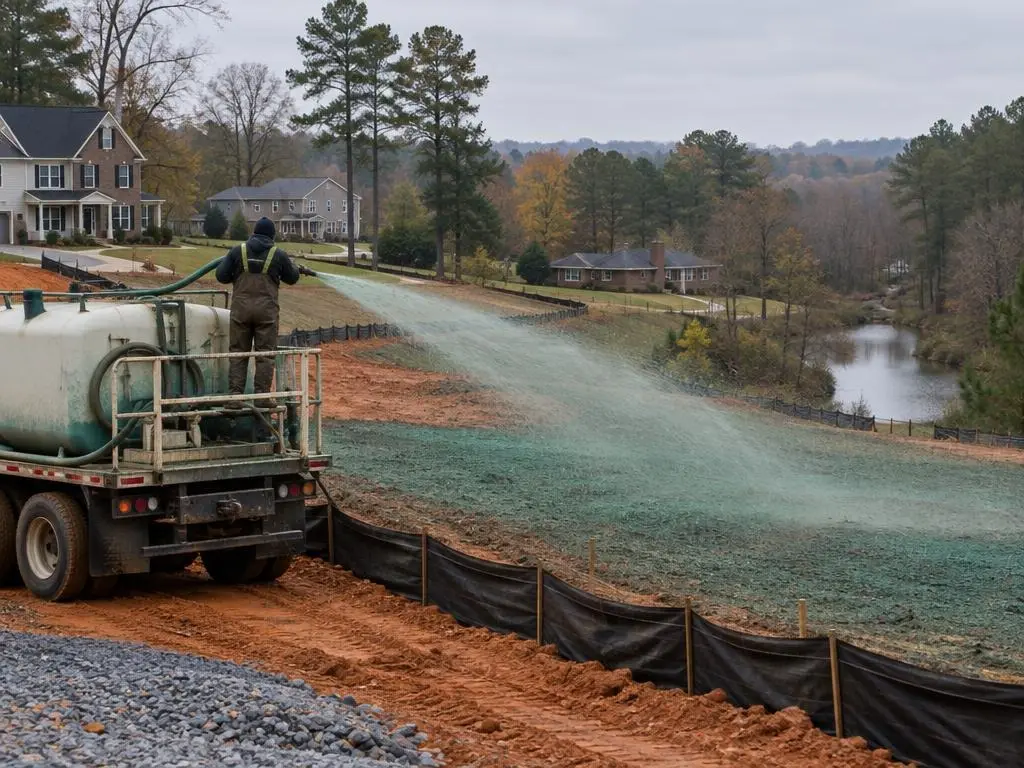
Why Homeowners Call Hydroseeding Raleigh
Soil check before the quote
We look at whether the seed will sit on topsoil or bare red clay and price the prep to match, instead of finding out after the grass fails.
Seed chosen by sun and season
Fescue, bermuda or zoysia, picked for your shade, how the yard is used and the time of year.
Built for storm season
Mulch rates and tackifier go up on slopes and on late-summer jobs, when heavy rain is most likely.
One crew from silt fence to grass
Sediment control, grading and seeding handled together, so a site does not sit bare waiting for the next trade.
Ready to Cover That Bare Dirt?
We come look at the ground in Raleigh and nearby towns at no cost, then send the quote in writing.